Today, a large proportion of security incidents start with a service unnecessarily exposed to the Internet.
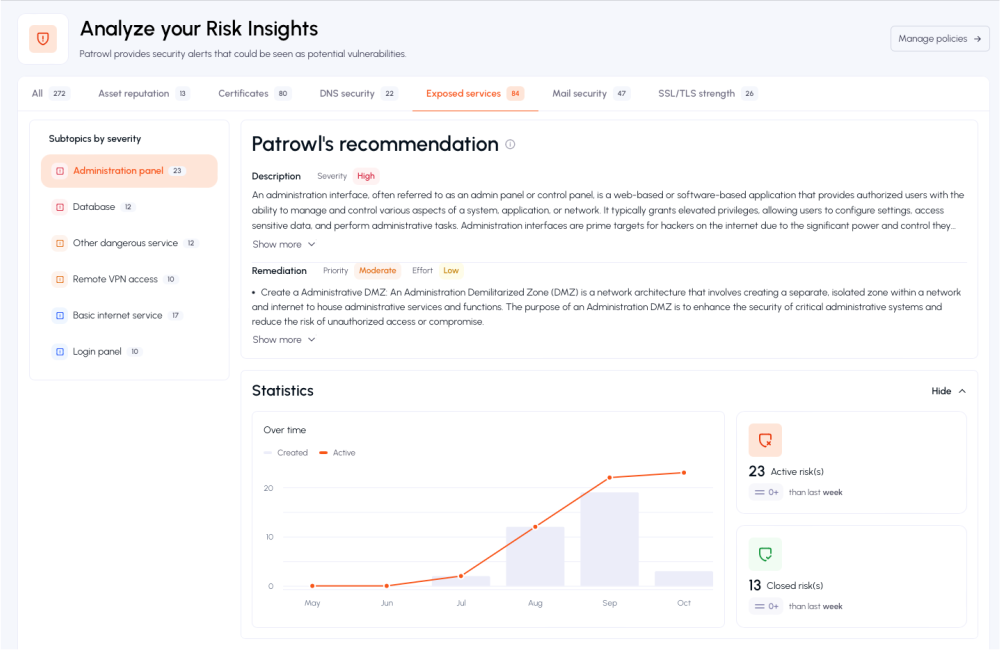
Exposed Services by Patrowl was designed to address this exact challenge. Most security incidents start with a service unnecessarily exposed to the Internet. Exposed Services by Patrowl enables you to identify, assess, and prioritize these risks in one click, through a dashboard built around real-world use cases and adapted to your security maturity.
What is this feature for?
Exposed Services enables organizations to collect, qualify, and visualize exposed Internet-facing services in a single click, along with their associated security issues, directly from a dashboard built around concrete, real-world use cases.
Every organization has its own security policies and level of maturity. Exposed Services adapts to this context to identify real-world bad practices — not theoretical risks.
The most frequently exposed services on the internet
Within Patrowl dashboard, 7 exposed service categories are organized by specific use cases, allowing immediate risk identification and clear visibility:
Administration Panels
An administration interface—often referred to as an admin panel or control panel—is a web or software application that allows authorized users to manage and control various aspects of a system, application, or network. These interfaces usually grant high-level privileges, enabling users to configure settings, access sensitive data, and perform administrative tasks. Due to the significant level of control they provide, administration panels are prime targets for attackers. The compromise of administration panels can lead to the compromise of the whole managed area resulting in data exfiltration (leak), ransomware, defacement, relay for other attacks...
Databases
Databases reference all exposed databases that may contain sensitive information but also may be misconfigured or be impacted by vulnerabilities. They are high-value targets for attackers due to the sensitive and valuable information they typically store, such as user credentials, financial data, and personal information. Exploiting vulnerabilities in exposed databases can lead to unauthorized access, data exfiltration (leak), and abuse. Additionally, databases are particularly vulnerable to ransomware attacks, where malicious actors encrypt critical data and demand payment for its release, posing serious risks to both operations and data security. Depending on the Security Policy, it is strongly recommended not to expose them on the Internet.
Cloud Storage
Cloud storage services (such as AWS S3, Google Cloud Storage, and Azure Blob Storage) provide highly available and scalable repositories—often called buckets or containers—for storing and delivering data, applications, and static content.
Misconfigurations, especially those allowing public or overly permissive access, introduce significant security risks. Improper permissions may allow attackers to list, download, modify, or delete files, or even inject malicious code into applications.
Example: In July 2025, part of the data from the online application Tea was stolen after being stored in an unsecured cloud storage service. The exposed data mainly included user photos and images of identity documents used for account verification.
Other Dangerous Services
This category includes services that should never be exposed to the Internet. Many Internet-facing services have historically been targeted and exploited due to vulnerabilities or misconfigurations. These services—used for technical operations, administration, monitoring, or file sharing—often rely on weak or unsecured protocols, making them attractive targets for malicious actors. The most unfamous are RDP, SMB and VNC, but there are many others, identified by this category.
Remote VPN Access
VPN interfaces are privileged access that often provide access to organization’s internal information systems. They are prime targets for attackers, as compromising these gateways provides direct access to an organization’s internal network. Successful VPN attacks can result in unauthorized access to sensitive resources, interception of confidential data, and lateral movement within the network.
Such compromises significantly increase the risk of ransomware attacks, as attackers can leverage VPN access to deploy and propagate ransomware, potentially crippling operations and demanding ransom payments for data decryption or system restoration. Listing and securing VPN interfaces is therefore critical to prevent unauthorized access and mitigate data breaches as well as ransomware attacks.
Basic Internet Services
The external perimeter of a network exposed to the Internet hosts many services. Some of these—such as email services or SSH—are intentionally exposed and widely used worldwide and do not necessarily represent an immediate threat. However, understanding and securing these services is a key component of a comprehensive security and compliance strategy.
Example: SSH, commonly hosted on port 22, should be hidden or access-restricted whenever it is possible.
Login Panels
A login panel is an interface or web page that allows users to enter credentials—such as a username,password and ideally a MFA —to access a secured system, application, or online service. It acts as a gateway for user authentication and access to platform features or data.
In many cases, exposing a login panel to the Internet is intentional and part of standard online service functionality (SSO login, file-sharing platforms, webmail, collaboration tools, etc.). However, the critical factor is the security level of the exposed login panel and the data it protects. When insufficiently secured, login panels may be vulnerable due to misconfigurations, oversights, or unpatched vulnerabilities, leading to unauthorized access and security breaches.
This category helps identify authentication portals visible from the outside, including solutions such as Fortinet and Palo Alto.